
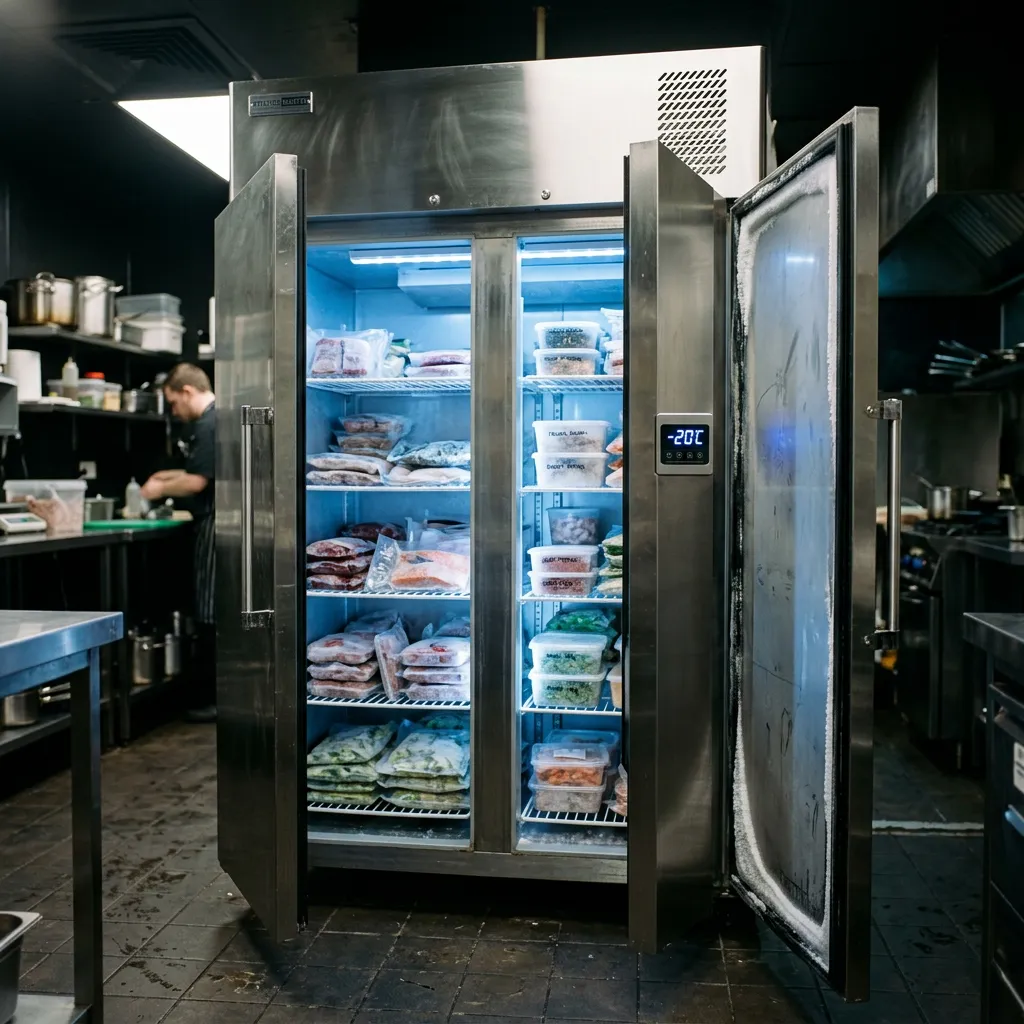
If your operation handles any frozen product — raw proteins, prepared meals, ice cream, pastry, or bulk ingredients — your commercial freezer is one of the most critical pieces of equipment in your kitchen. Get the capacity, temperature range, or configuration wrong and you are looking at spoilage, compliance failures, and expensive emergency purchases.
This guide covers everything you need to know to choose the right commercial freezer for your operation: the main types available, key specifications to compare, and the questions you should ask before you buy.
Why Commercial Freezers Are Not Interchangeable with Domestic Units
A domestic freezer is built for occasional opening and passive storage. A commercial freezer is built for a completely different environment: frequent door openings, high ambient kitchen temperatures, heavy loading cycles, and continuous operation across long service shifts.
The difference shows up in three areas. Recovery time — how quickly the unit returns to set temperature after a door opening — is far faster on a commercial unit. Build quality uses heavier-gauge stainless steel internally and externally, designed to withstand daily impact from racks, trays, and kitchen activity. And critically, commercial units are designed to maintain safe food temperatures under load, not just in ideal conditions.
Running domestic-grade freezing equipment in a commercial kitchen is also a food safety compliance issue in most Australian jurisdictions. FSANZ food safety standards require that frozen food be stored at or below -15°C, and commercial units are engineered and certified to maintain that consistently.
Types of Commercial Freezers
Chest Freezers
The chest freezer is the most energy-efficient configuration available. Cold air is denser than warm air and sinks, so a top-opening chest freezer loses very little cold air each time it is opened. This makes chest freezers ideal for bulk storage of items that do not need to be accessed frequently throughout service.
Common applications include ice cream and dessert storage, bulk protein storage in butcher shops and fish markets, and backup frozen stock in high-volume production kitchens. Chest freezers are typically the most affordable option per litre of storage and have low running costs.
The trade-off is accessibility. Chest freezers require staff to reach into the unit, which can be difficult for deep models or when the unit is heavily loaded. Organisation is harder to maintain and FIFO rotation requires discipline.
Upright Freezers
Upright freezers offer front-opening access with internal shelving, making them far easier to organise and rotate stock efficiently. They take up a smaller floor footprint than a chest freezer of equivalent capacity and are the standard choice for kitchens where multiple staff need regular access throughout service.
Upright commercial freezers come in single-door, double-door, and triple-door configurations depending on capacity requirements. Solid door models offer maximum temperature stability. Glass door models are common in retail and display contexts where product visibility is important.
The energy efficiency trade-off versus chest freezers is real but manageable. In a well-ventilated kitchen with reasonable ambient temperatures, a quality upright freezer running on a modern compressor system will add only moderate running costs relative to its operational convenience.
Underbench Freezers
Underbench freezers are compact units designed to fit beneath a standard kitchen workbench, typically 850mm in height with a 600mm or 700mm footprint. They serve two main purposes: as primary freezer storage in smaller operations with limited floor space, and as a satellite unit positioned at the point of use in larger kitchens.
A pizza operation, for example, might use a large upright freezer for bulk stock but place an underbench freezer directly beneath the prep bench for fast access to proteins, pastry, or pre-portioned product during service. This reduces the number of trips across the kitchen and keeps the primary storage unit closed.
Underbench freezers are available in drawer or door configurations and are generally compatible with standard stainless steel benchtop systems.
Blast Chillers and Blast Freezers
A blast chiller is not technically a storage freezer — it is a rapid temperature reduction unit designed to take food from cooking temperature to safe storage temperature as quickly as possible. Under HACCP food safety requirements, cooked food must pass through the temperature danger zone (60°C to 5°C) as rapidly as possible to inhibit bacterial growth.
Blast freezers take this further, rapidly reducing product to below -18°C. This is used in cook-freeze operations, large-scale catering production, and any environment where batch cooking and advance preparation is central to the workflow.
If your operation does significant batch cooking, or you are looking to extend shelf life on prepared product, a blast chiller or blast freezer should be considered as part of your cold chain infrastructure — not just a storage solution.
Key Specifications to Compare
Temperature Range
Most commercial freezers operate between -18°C and -22°C for standard frozen storage. Units designed for ice cream service typically operate at -22°C to -25°C, as ice cream needs to be held firmer than standard frozen goods to maintain scoop consistency.
Check that the unit’s rated temperature range is achievable at the ambient temperatures in your specific environment. A unit rated to -18°C in a 25°C ambient may struggle in a hot kitchen running at 35°C during peak service. Manufacturer specifications should state the ambient temperature at which the rating applies.
Capacity
Commercial freezer capacity is measured in litres for chest and upright models. Do not size purely on current volume — consider your peak period requirements, your ordering frequency, and any planned menu or volume growth. A unit that is at 90% capacity creates problems; product stacked against the walls or blocking airflow can result in uneven temperatures and inconsistent freezing.
As a general rule, buy more capacity than you currently need. The cost difference between model sizes is typically small relative to the operational headache of an undersized unit.
Compressor Type and Location
The compressor is the core of any refrigeration system. Commercial freezers use either top-mounted or bottom-mounted compressors. Top-mounted compressors are more common in commercial applications because they are further from the floor-level heat sources of a kitchen and easier to service and clean around.
In hot kitchen environments, ensure the compressor has adequate clearance for airflow. Blocking the condenser with equipment or against a wall is a common cause of premature compressor failure and temperature performance issues.
Door Seals and Gaskets
Check the door gasket quality on any unit you are considering. Gasket failure is one of the most common causes of commercial freezer underperformance — the unit runs constantly trying to compensate for cold air leakage. Quality units use magnetic gaskets with positive closure across the full door perimeter.
Replaceable gaskets are a must-have. On a commercial unit running seven days a week, the gasket will need replacement over time and should be a standard maintenance item, not a specialist repair.
Energy Efficiency
Commercial freezers run 24 hours a day, 7 days a week. A unit with a poor energy rating will cost significantly more to operate annually than a higher-efficiency model. Check the annual energy consumption figure (kWh/year) rather than just the star rating, and factor in your local electricity cost when comparing total cost of ownership between models.
Inverter compressor technology, where available on commercial units, can reduce energy consumption by varying compressor speed to match demand rather than cycling on and off at full power.
Configuration Considerations for Australian Kitchens
Ambient Temperature
Australian commercial kitchens often run at higher ambient temperatures than European or North American environments, particularly in Queensland, the Northern Territory, and Western Australia. Specify your worst-case ambient temperature when talking to a supplier and confirm the unit is rated to maintain target temperature under those conditions.
Power Supply
Larger commercial freezers — particularly three-door uprights and blast freezers — may require three-phase power. Confirm your venue’s power supply configuration before purchasing. Single-phase units will run on standard commercial power; three-phase units will require an electrician to install a dedicated circuit if one does not already exist.
Service and Parts Availability
Australian commercial kitchens operate with long service periods and tight margins. A freezer failure during a busy Friday service is a serious operational problem. When selecting a brand and model, check that authorised service technicians are available in your area and that replacement parts are stocked locally, not imported to order.
Established brands with a strong Australian service network — including those distributed through Snowmaster Australia — provide a significant practical advantage in after-sales support.
Maintenance Basics
A commercial freezer requires minimal but consistent maintenance to perform reliably over its operational life.
- Clean the condenser coils every three months. Dust and grease buildup on the condenser is the most common cause of refrigeration inefficiency and compressor overload.
- Check door seals monthly for damage, gaps, or loss of magnetic closure. A failing seal should be replaced immediately.
- Defrost the unit on the manufacturer’s recommended schedule. Frost buildup on evaporator coils reduces cooling efficiency and eventually leads to temperature problems.
- Keep a 10cm clearance around the unit for airflow, particularly around the condenser.
- Log temperature readings as part of your food safety monitoring. Unusual temperature variation is often the first sign of a developing mechanical issue.
Tip: Most commercial freezer failures are preceded by a gradual decline in temperature performance. A digital thermometer log will catch this before it becomes an emergency.
Questions to Ask Before You Buy
- What is the ambient temperature rating — at what ambient does the quoted operating temperature apply?
- Is the compressor top or bottom mounted, and what clearance is required?
- Is the unit single or three phase?
- What is the annual energy consumption in kWh/year?
- Are gaskets user-replaceable and readily available?
- Is there a local authorised service agent, and what is the parts lead time?
- What warranty is provided, and does it cover both parts and labour?
A commercial freezer is a long-term investment. The right unit for your operation will run reliably for a decade or more with proper maintenance. Taking the time to specify correctly at the point of purchase is significantly cheaper than dealing with the consequences of an undersized or underpowered unit once it is in service.
Snowmaster Australia has supplied commercial refrigeration equipment to Australian food businesses since 1945. Their range of commercial freezers covers chest, upright, and underbench configurations from leading brands with Australian service support.