
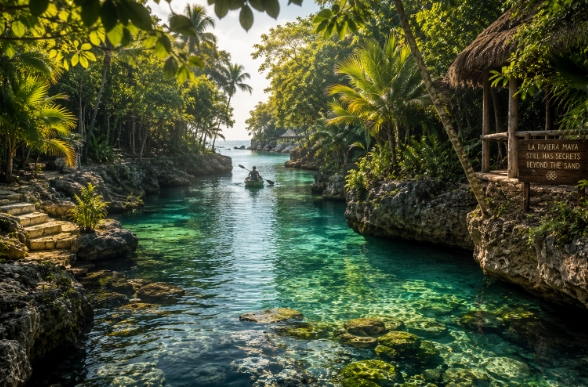
Cancún gets the flights. Playa del Carmen gets the nightlife. Tulum gets the aesthetic. And somewhere between all three, the actual Riviera Maya, the one that has been here for centuries, quietly gets overlooked.
That is the version worth finding.
Behind the hotel zones and the all-inclusive gates sits a stretch of land that contains underground rivers, jungle-covered Mayan cities, a reef the size of a small country, and towns where the Sunday market is still the main event of the week. None of it is hard to reach. Most of it simply requires the decision to look past the beach for a day.
One practical step before you fly — Quintana Roo charges an environmental fee from all visitors. The Tourism Tax for Quintana Roo is paid online before you leave and takes under five minutes. The money funds conservation and infrastructure across the state. Sort it early and move on.
Underground Water That Doesn’t Look Real
The entire Yucatán Peninsula sits on top of a limestone shelf riddled with caves. Where the roof has fallen in over thousands of years, you get a cenote, an open sinkhole filled with groundwater so clear that the bottom looks closer than it is.
The Sistema Dos Ojos near Tulum has over 82 kilometers of mapped underwater passages according to the Quintana Roo Speleological Survey, one of the longest explored cave systems anywhere on earth. Snorkeling through it feels less like swimming and more like floating through a cathedral that nobody built.
The cenotes that stay with you are rarely the famous ones. They are the ones down a dirt road with a handwritten sign, no ticket booth, and a single rope tied to a tree for climbing back out. Those still exist. You just have to drive past the ones with parking lots to find them.
Cities Built Before Anyone Was Counting
Inland from the coast, the jungle holds cities that were already old when Europe was still figuring itself out.
Cobá sits deep in the trees two hours from the main tourist strip. Its tallest pyramid, Nohoch Mul, rises 42 meters above the jungle floor. The view from the top is nothing but green in every direction, broken only by the occasional flash of a distant lake. It does not feel curated. It feels found.
Closer to the coast, Tulum’s ruins sit on a cliff directly above the Caribbean, the most dramatically placed archaeological site in Mexico by a significant margin. According to Mexico’s National Institute of Anthropology and History, Tulum drew over 2.5 million visitors in 2024. Go before 8am. The difference is not small.
Two Towns That Most Visitors Drive Past
Bacalar sits four hours south of Cancún on a lake that shifts through six or seven distinct shades of blue depending on the depth and the time of day. There are no large resorts here. There are hammocks over the water, small sailboats, a Spanish fort from the 1700s, and evenings that go quiet by ten o’clock. It is the kind of place people intend to spend one night and end up staying four.

Valladolid sits inland on the road toward Chichén Itzá and most tour buses stop only for fuel. That is a genuine mistake. The town has a colonial square that actually functions as a community space rather than a tourist set piece, a cenote sitting right in the middle of the city, and market food that ranks among the best eating in the entire region.
According to SECTUR Mexico, visits to smaller inland towns across Quintana Roo and Yucatán rose by 28% between 2022 and 2024. Travelers are starting to figure out what locals already know.
The Reef and the Food That Go With It
The Mesoamerican Barrier Reef runs the full length of this coastline, the second largest coral reef system in the world according to the World Wildlife Fund. Puerto Morelos, a small fishing town between Cancún and Playa del Carmen, sits directly beside it. The reef here is healthy, the water is calm, and on a weekday morning the boats are mostly empty.

On land, the food that defines this region is cochinita pibil, pork marinated in achiote paste and bitter orange, wrapped in banana leaves, and slow-cooked underground for hours. The best version is not in any restaurant. It is at a market stall in Valladolid on a Sunday morning, served on a fresh tortilla, handed to you wrapped in paper, eaten standing up. It costs almost nothing and tastes like the entire region on one plate.
What the Resort Was Never Going to Show You
The all-inclusive model is honest about what it offers. Comfort, convenience, and a version of the destination that has been smoothed down until nothing surprises you.
The Riviera Maya outside those gates is rougher, louder, harder to navigate, and considerably more interesting. Underground rivers that scientists are still mapping. Market towns that run on their own schedule. A reef system old enough to have existed before the first tourist ever arrived.
All of it sits within an hour of most resorts on the coast. The only thing standing between you and it is the decision to leave the property for a day.
That decision is worth making.