
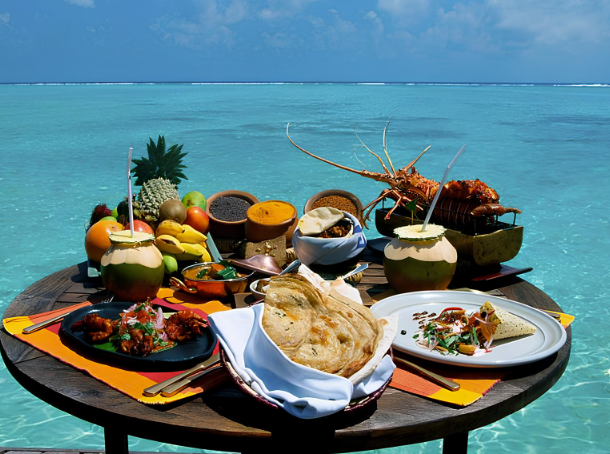
For decades, visitors arrived for the overwater villas and left having eaten little that was actually Maldivian. That is changing and the chefs leading the shift grew up fishing these atolls.
The tuna arrives at Malé’s fish market before most travelers are awake. By 5 a.m., skipjack and yellowfin are already moving off the quayside, pole-and-line caught, without nets, in the same sustainable tradition the islands have maintained for centuries. The morning auction is over by 7 a.m., and by the time the first flights touch down at Velana International Airport, the catch has already found its way into kitchens across the capital. Every visitor on those flights must hold a completed Maldives itd, the International Travel Declaration required of all arrivals regardless of nationality, before clearing immigration. That formality, brief as it is, marks the beginning of one of the most underrated food experiences in the Indian Ocean.
For most of the Maldives’ tourism era, which began in earnest in the 1970s, the islands’ own cuisine existed in the background. Resorts, which import an estimated 90 percent of their food, built dining programs around international menus that had little to do with what Maldivians actually eat. That gap is narrowing fast. A new generation of island-born chefs is placing mas huni, garudhiya, and rihaakuru at the center of the dining conversation, and the global appetite for authentic culinary experience is meeting them exactly where they stand. According to a 2026 culinary tourism market report, the sector reached $1.06 trillion in 2025 and is growing at 15.6 percent annually — driven, in large part, by travelers who now choose destinations based on what they can eat there, not just where they can sleep.
Three Ingredients, One Identity
Maldivian cuisine is built on a constraint that became an art form. With no large-scale agriculture and no rivers across its 1,200 islands, the kitchen had three foundations: tuna, coconut, and chili. Maldivian cooks turned those components into dozens of distinct dishes through technique and a precision with spice that visitors consistently underestimate.
Mas huni, the national breakfast, captures the principle precisely. Shredded smoked tuna mixed by hand with freshly grated coconut, diced onion, and green chili, served alongside roshi, a soft flatbread with sweetened black tea. It is a dish of remarkable balance: smoky, bright, faintly creamy, and warm with heat that builds slowly. Garudhiya, a clear tuna broth simmered with curry leaves and lime, is its counterpart at lunch: minimal, deeply savory, served with rice and fresh lime. Then there is rihaakuru, a thick, dark fish paste made by reducing tuna to pure concentrated umami, still made in island homes, still eaten with rice the same way it has been for centuries.

“Fresh tuna, coconut, and subtle spices come together in dishes that tell the story of island life.” — Chef Kristoffer Ace Reynes, Sun Siyam Resorts
The Chefs Bringing It Forward
The revival is being led by Maldivian chefs who grew up eating this food and trained abroad before returning to reinterpret it. At Patina Maldives, Chef de Cuisine Abdulla “Rippe” Rifzan, who grew up in Gemanafushi, runs KOEN, a fine-dining menu with Nordic aesthetics and Japanese technique built around what he calls “Mas Huni 2.0”: smoked bonito, Kampot pepper, curry leaves, coconut, and lime, the original dish rebuilt with precision. According to the Hilton 2024 Trend Report, 64 percent of travelers now explicitly prefer unique local experiences over traditional fine dining, a shift that is validating exactly the direction chefs like Rifzan have been moving. Separately, an American Express survey found that 81 percent of travelers look forward to food experiences when abroad. In a destination where the food experience has historically been invisible, both figures carry particular weight.
Kaagé at VARU by Atmosphere serves snapper in coconut gravy and crisp tuna cutlets inside a restaurant built to resemble a traditional island house. At Milaidhoo, Ba’theli dishes its menu from a restored traditional boat floating in the lagoon. At NH Maldives Kuda Rah, hands-on classes teach mas huni and garudhiya using produce from the resort’s own garden. The teaching is the point: the revival is not only on the plate.
Where to Find It Beyond the Resort
The most unmediated version of Maldivian food exists on the local islands. Maafushi, a 45-minute speedboat ride from Malé, has a growing cluster of family-run cafes serving hedhikaa tuna pastries, cutlets, and fish balls throughout the day. Fuvahmulah, a single-island atoll in the deep south with its own freshwater lake and farmland, is regarded by food-focused visitors as the most traditional culinary experience in the country. In Malé itself, the fish market is the best first stop: the tuna auction that begins before dawn is the moment at which fish becomes food, before the resort economy applies its own logic to both.
The version of the Maldives that most visitors miss is not in the ocean it is in the kitchen. It is a woman grating coconut on a hunigondi before sunrise, a bowl of garudhiya so clear you can see the bottom of the bowl, a smear of rihaakuru on roshi that has been eaten this way for 800 years. The chefs finding ways to present that food to the world are not reinventing it. They are, finally, making sure it is seen.